
 Helpdesk
 Solution Center









Leading companies worldwide like Bosch, BMW, Mercedes-Benz, VW, Continental, Infineon, Schaeffler and many more trust agosense.symphony
 agosense.symphony
Salesforce Connector & Salesforce Integration
with Jira, Codebeamer & Azure DevOps
The agosense.symphony Salesforce Connector connects Salesforce bidirectionally with your ALM and DevOps tools – from Jira and Azure DevOps to Codebeamer and PTC Windchill RV&S. Incidents, cases and feature requests flow automatically into your development toolchain – without manual effort, without data silos, in real time.
✓ Bidirectional & real-time
✓ 150+ customer projects
✓ 15+ years of experience
✓ Made in Germany / Europe
Connects Salesforce with
 ⇄
⇄
Jira
Azure DevOps
Codebeamer
PTC Windchill RV&S
IBM DOORS
ServiceNow
Siemens Polarion
+ All integrations →
Background
Why a seamless Salesforce Integration is essential today
Salesforce is central to many organizations – as a CRM platform for sales teams and as a Service Cloud for customer support. At the same time, development teams work in specialized ALM and DevOps tools: Jira, Codebeamer, Azure DevOps or PTC Windchill RV&S. Three teams, three worlds – and a gap between them that costs time every single day.
A sales rep logs a feature request in Salesforce and hopes the information somehow reaches development. A support agent reports a critical bug as a case – and only learns about the fix after following up personally. A developer closes a ticket, but the account manager sees nothing. The result: duplicated effort, delays, missing traceability – across every team boundary.
The agosense.symphony Salesforce Connector solves this structurally: data flows automatically and rule-based between Salesforce and your development toolchain – bidirectionally, in real time and fully traceable. No manual follow-up, no lost information, no data silos.
Technology
The agosense.symphony Salesforce Connector: Flexible, scalable, enterprise-ready
agosense.symphony acts as middleware between Salesforce and your ALM and DevOps tools. The connection to Salesforce is established via the native REST API – no additional Salesforce modules or plugins required. On the other side, the Connector supports all leading target systems: Jira (Data Center, Server and Cloud), Azure DevOps, Codebeamer, PTC Windchill RV&S, IBM DOORS and more. Configured once, the Salesforce Connector then runs fully automatically in the background.
Field mapping: Every field, every logic
All fields from Salesforce cases, opportunities and other objects can be freely mapped to fields in the target system. Formulas, lookups and conditional rules enable precise transformations – even when the data models of both systems differ significantly.
Triggers: Synchronization on your terms
You decide when and how the Salesforce Connector activates: scheduled, event-based – for example on a status change in Salesforce – or manually. Any process logic can be mapped without touching Salesforce or the target system directly.
Conflict management: Rule-based & transparent
When changes occur in both systems simultaneously, agosense.symphony resolves conflicts rule-based – configurable, transparent and without data loss. Every decision is recorded in the audit log and remains traceable at any time.
Monitoring: Complete logging
All synchronization processes are fully logged. The central monitoring dashboard gives you an overview of sync status, error sources and processing times – for all connected systems simultaneously and in real time.
What would the Salesforce Connector look like in your environment?
Tell us about your current tool landscape – our integration experts will walk you through how the agosense.symphony Salesforce Connector connects sales, support and development in your individual setup. With a proof of concept or test installation to follow, if desired. No cost, no risk – but a clear picture of what's possible.
Book a free analysis call →
Comparison
Salesforce Connector or integration platform – what's right for your organization?
Many teams start with a rigid Salesforce Connector or a custom-built interface. What works initially quickly becomes a bottleneck as the tool landscape grows and data volumes increase. Here's a direct comparison:
★ Recommended
| Criterion | Rigid Connector / Zapier | Custom development | agosense.symphony |
|---|---|---|---|
| Implementation effort | Low (initially) | Very high | Low |
| Bidirectional synchronization | Limited | Complex | Full |
| Supported Salesforce objects | Limited | Individual | Comprehensive |
| Extensibility to further tools | Not possible | Very complex | Extendable at any time |
| Field mapping & transformation | Simple 1:1 mapping | Individual, but costly | Formulas, lookups, rules |
| Audit trail & compliance | Not available | Individual | Complete |
| Maintenance / API updates | High | Very high | Covered by vendor |
| Scalability | None | Medium | High |
Rigid Connector / Zapier
Implementation effortLow (initially)
Bidirectional syncLimited
Salesforce objectsLimited
ExtensibilityNot possible
Field mappingSimple 1:1 mapping
Audit trailNot available
Maintenance / API updatesHigh
ScalabilityNone
Custom development
Implementation effortVery high
Bidirectional syncComplex
Salesforce objectsIndividual
ExtensibilityVery complex
Field mappingIndividual, but costly
Audit trailIndividual
Maintenance / API updatesVery high
ScalabilityMedium
agosense.symphony ★ Recommended
Implementation effortLow
Bidirectional syncFull
Salesforce objectsComprehensive
ExtensibilityExtendable at any time
Field mappingFormulas, lookups, rules
Audit trailComplete
Maintenance / API updatesCovered by vendor
ScalabilityHigh
Supported systems
The Salesforce Connector integrates Salesforce with your entire tool landscape
agosense.symphony provides pre-configured adapters for all leading ALM, DevOps and ITSM systems. Whether your team uses Jira for defect management, Codebeamer for requirements and testing, or Azure DevOps for sprint operations – the Salesforce Connector is typically ready to use quickly and can be extended to further tools at any time.
ALM & Requirements Management
IT Service Management (ITSM)
Project Management & Agile
Automotive OEM portals
Use cases
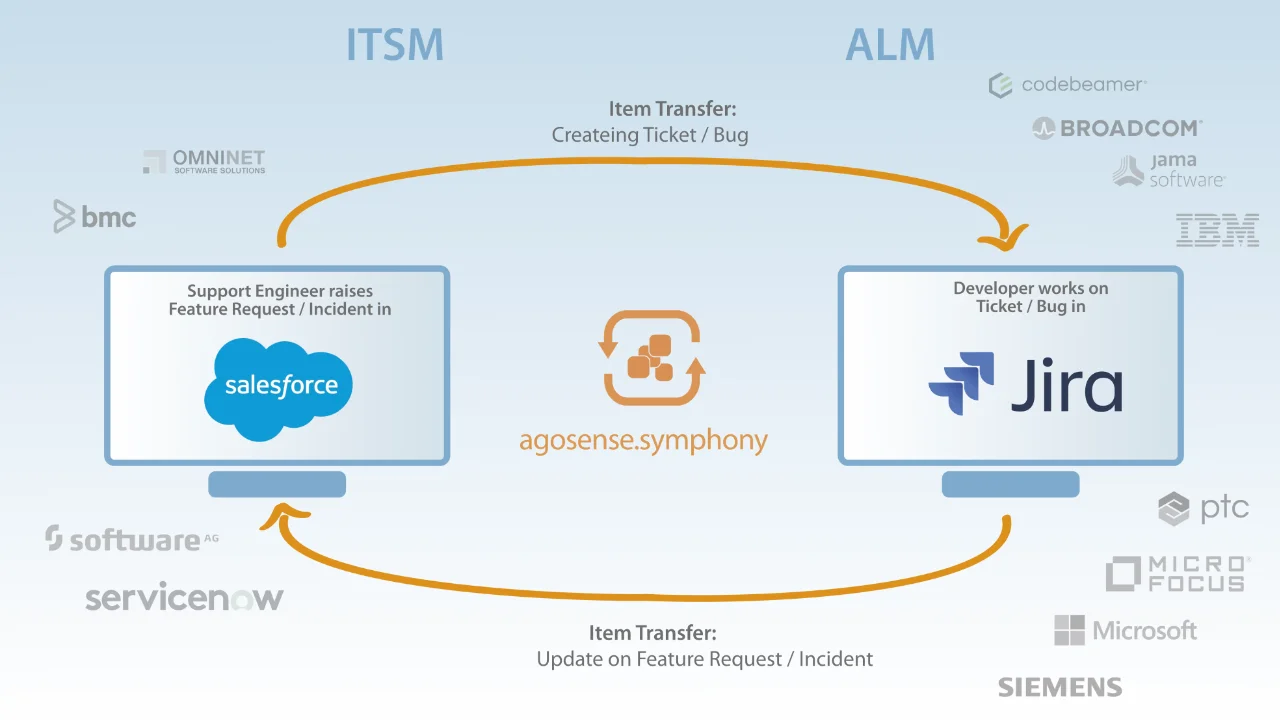
Typical use cases for the Salesforce Connector
Salesforce & Jira
Incident management: From Salesforce case to Jira issue
The most common scenario in enterprise environments: support teams log customer problems in Salesforce as cases or incidents, while development organizes its work in Jira. Without automation, a data silo emerges – information gets lost, status updates are delayed, and account managers only learn about a completed bugfix after following up personally. With the agosense.symphony Salesforce Connector, cases are created rule-based as Jira issues, statuses and comments are synchronized bidirectionally, and attachments are transferred automatically – completely, in real time, without manual intervention.
Salesforce & Codebeamer · Regulated industries
Feature requests directly into requirements management – for automotive, aerospace & medical devices
In regulated industries, forwarding a customer request by email is not enough. A feature request logged in Salesforce as an opportunity or case must land traceably as a requirement in Codebeamer or PTC Windchill RV&S – linked to test cases, change requests and the entire development history. The agosense.symphony Salesforce Connector maps exactly this process chain: fully automated, completely logged and compliant with ASPICE, ISO 26262 and IEC 62304. Sales and development work in their preferred tools – and still share the same data status.
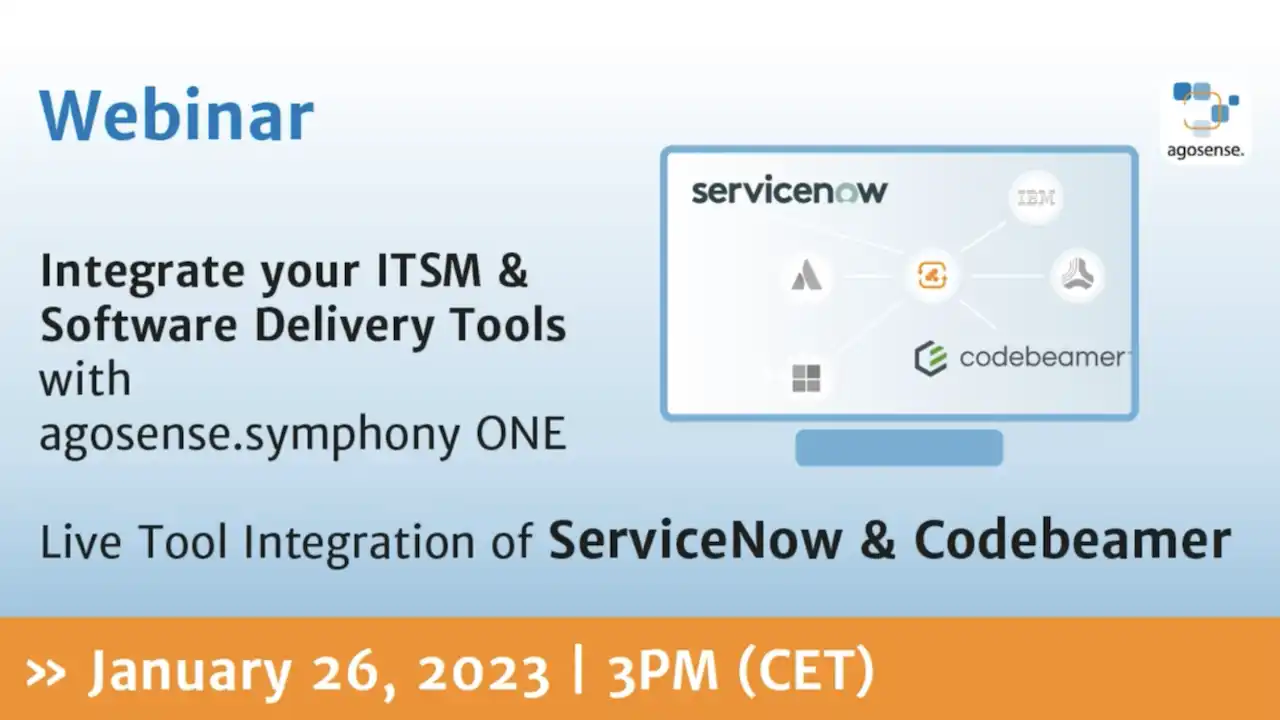
Webinar recording excerpt
ITSM & ALM Integration via agosense.symphony – Salesforce as ITSM tool, Codebeamer as ALM system
Salesforce & Azure DevOps
From support ticket to work item: Salesforce & Azure DevOps
For development teams in Microsoft environments, the Salesforce Connector connects cases directly with Azure DevOps work items. An incident in Salesforce is created rule-based as a bug or user story in Azure DevOps – including description, priority and attachments. Status changes flow bidirectionally: the support team sees in Salesforce when the fix is complete. The development team works undisturbed in Azure DevOps. No duplicate entry, no loss of information.
Multi-tool Integration
Salesforce in the complex enterprise toolchain
agosense.symphony is not limited to a fixed tool combination. The Salesforce Connector can be embedded in multi-level toolchains: a change request starts in Salesforce, is created as a requirement in PTC Windchill RV&S and simultaneously synchronized in Codebeamer for test management – with status information, comments and attachments across all systems. That is exactly what sets agosense apart from rigid point-to-point solutions: a centrally managed integration platform that grows with your tool landscape.
Advantages
Salesforce Connector with agosense.symphony: Advantages at a glance
| Feature | agosense.symphony |
|---|---|
| Synchronization direction | Bidirectional, in real time |
| Supported Salesforce products | Service Cloud, Sales Cloud & further Salesforce instances |
| Configuration | Point & click, no programming skills required |
| Triggers | Scheduled, event-based or manual – freely configurable |
| Field mapping & data logic | Comments, file attachments and conditional mappings |
| Conflict handling | Rule-based, fully logged |
| Monitoring & logging | Central dashboard, complete logging of all sync processes |
| Audit trail | Complete, mappable to ASPICE & ISO 26262 |
| Scalability | Enterprise-ready, multi-instance, multi-project |
| Extensibility | 50+ adapters, extendable to further tools at any time |
| OEM portal connectivity | Unique: BMW, Mercedes-Benz (incl. STARC), Porsche, VW |
| Origin & experience | Made in Germany / Europe, 15+ years of expertise |
| Customer projects | 150+ successfully completed |
Synchronization directionBidirectional, in real time
Supported Salesforce productsService Cloud, Sales Cloud & further instances
ConfigurationPoint & click, no programming skills required
TriggersScheduled, event-based or manual
Field mapping & data logicComments, attachments and conditional mappings
Conflict handlingRule-based, fully logged
Monitoring & loggingCentral dashboard, complete logging
Audit trailComplete, ASPICE & ISO 26262 compliant
ScalabilityEnterprise-ready, multi-instance, multi-project
Extensibility50+ adapters, extendable at any time
OEM portal connectivityUnique: BMW, Mercedes-Benz (incl. STARC), Porsche, VW
Origin & experienceMade in Germany / Europe, 15+ years
Customer projects150+ successfully completed
References
What customers say about agosense.symphony
Deciding which integration platform to deploy across a large development organization is a significant responsibility.
That is why real-world experience speaks louder than any promise:
“
agosense.symphony is an essential component of our organization's integration landscape. By using this platform, we have successfully implemented and maintained complex and secure integrations over time, both between our internal systems and our clients' systems. This has allowed us to ensure reliable data synchronization and consistently deliver high-quality services.
“

Internal and cross-company integrations will be key priorities for IT in the coming years. With an open integration platform like agosense.symphony, we hope to be well prepared for the future.
FAQ
Frequently asked questions about the Salesforce Connector
agosense.symphony provides adapters for all common ALM, DevOps and project management tools, including Atlassian Jira (Data Center, Server and Cloud), Microsoft Azure DevOps, Codebeamer, PTC Windchill RV&S, IBM DOORS, IBM DOORS Next, Siemens Polarion and ServiceNow. A full overview is available at agosense.com/integrations.
The agosense.symphony Salesforce Connector is compatible with all Salesforce instances that support the REST API – including Salesforce Service Cloud and Salesforce Sales Cloud (CRM). No additional Salesforce apps or plugins are required.
Yes. The Salesforce Connector synchronizes not only field data but also attachments, comments and linked objects – depending on what the API of the respective target system supports.
Yes. In addition to scheduled synchronization runs, agosense.symphony also supports event-based triggers that enable near real-time data transfer – for example when a new case is created in Salesforce or a status changes in the target system.
No. The Salesforce Connector is configured via a point-and-click interface with a graphical wizard. For complex enterprise scenarios, the agosense consulting team is available to support you.
First synchronizations are possible within a few hours depending on the scenario. A full enterprise integration is typically live within a few days – significantly faster than custom-built solutions.
Yes. agosense.symphony has been deployed in numerous projects in regulated development environments. Complete logging of all synchronization actions and end-to-end traceability are core components of the platform – ideal for automotive (ASPICE, ISO 26262), medical devices (IEC 62304) and aerospace (DO-178).
Licensing costs depend on the chosen license model and the number of connected systems. Contact us directly – we will put together an individual quote for you.
Integrate Salesforce – get started with agosense.symphony today
We analyse your tool landscape, discuss your individual situation and show you how a Salesforce Connector connects sales, support and development seamlessly in your environment – backed by 15+ years of experience and more than 150 successfully completed integration projects.
✓ Free analysis call
✓ Discuss your individual situation
✓ Proof of concept possible
✓ Test installation possible
No cost, no risk – but a clear picture of what the Salesforce Connector can do for your toolchain.
Or use our contact form directly

agosense GmbH
Stammheimer Strasse 10
70806 Kornwestheim
Germany
+49.7154.99951.0
mail@agosense.com
https://agosense.com
Stammheimer Strasse 10
70806 Kornwestheim
Germany
+49.7154.99951.0
mail@agosense.com
https://agosense.com
PRODUCTS & SOLUTIONS
AGOSENSE.SYMPHONY
DEVELOPMENT TOOL INTEGRATION
B2B DATA EXCHANGE
INTEGRATIONS
LICENSING
SOLUTION CENTER
AGOSENSE.SYMPHONY
DEVELOPMENT TOOL INTEGRATION
B2B DATA EXCHANGE
INTEGRATIONS
LICENSING
SOLUTION CENTER
This is agosense: Automation of data flows, value stream management, connection of development tools and ALM platforms, business-to-business data exchange, connection to OEM supplier platforms.
