
 Helpdesk
 Solution Center











Leading companies worldwide like Bosch, BMW, Mercedes-Benz, VW, Continental, Infineon, Schaeffler and many more trust agosense.symphony
 agosense.symphony · Made in Germany
Digital Thread: One continuous data flow for your software and systems development
A Digital Thread connects all data across your product lifecycle, from the first requirement through architecture, development and testing to operations and service. agosense.symphony extends this thread across your existing toolchain: Tool-agnostic, bidirectional and fully traceable. Every team keeps working in its own tool. The flow of information never breaks.
✓ Tool-agnostic Digital Thread Platform
✓ End-to-end traceability
✓ 150+ customer projects
✓ 15+ years of experience
✓ Made in Germany
Integrations include
Polarion
Codebeamer
IBM DOORS
Enterprise Architect
Jira
Azure DevOps
OpenText ALM
ServiceNow
Salesforce
BMW · Mercedes-Benz · Porsche · VW
+ All integrations →
Basics
What is a Digital Thread? Definition and example
A Digital Thread is the continuous, connected flow of data across the entire lifecycle of a product. It links product data from all systems involved so that every piece of information knows its origin, its dependencies and its current status. Instead of simply copying data, it creates a traceable chain: This requirement was realized in this architecture, implemented in this work item, verified by this test case and shipped with this release.
The term has its roots in aerospace and digital engineering, where it primarily connects design and manufacturing data in product lifecycle management. In software and systems development, it is rapidly gaining importance: This is where most changes happen and where software content and variant complexity grow fastest. It is also where data is spread across a particularly large number of specialized tools. A cross-industry definition is provided by the Digital Twin Consortium.
Explained simply
Imagine a common thread running through every stage of your development. Pull on it at any point, such as a changed requirement, and you immediately see which models, tasks, tests and customer tickets are attached to it. That is exactly what a Digital Thread does: It makes connections visible that would otherwise stay hidden in tool silos.
Real-world example
A customer reports a defect in an ECU via ServiceNow. The incident automatically lands as a defect in Jira, is linked to the affected requirement in Polarion and triggers a regression test. The test result flows back all the way to the customer's ticket. Nobody copies, nobody searches.
Distinction
Digital Thread vs. Digital Twin: The difference
The two terms are often mentioned in the same breath. Yet they describe different things and complement each other:
Digital Twin
A Digital Twin is a virtual representation of a real-world product, system or process. It mirrors state and behavior (often using real-time data from operations) and enables simulations, analyses and forecasts.
Digital Thread
The Digital Thread is the connective network behind it. It links data from requirements, development, testing and service across the entire lifecycle. This provides the origin and context a Digital Twin needs to deliver reliable insights.
In short: The Digital Twin shows what a product is. The Digital Thread shows how it got there – and why.
Challenges
Where the data thread breaks in development
Hardly any company works with just one tool. Requirements engineers use Polarion or Codebeamer, developers work in Jira or Azure DevOps, testers in their test management tool and service teams in ServiceNow or Salesforce. This best-of-breed strategy makes sense. But every handoff risks a break in the data flow:
Tool silos
Each system only knows its own slice. Connections across tool boundaries remain invisible.
Manual handoffs
Data is copied, exported and forwarded by email. This is error-prone and leaves no audit trail.
Outdated information
Status changes reach other teams too late. Decisions are based on yesterday's data.
Incomplete traceability
Proof from requirement to test is missing. Audits under ASPICE, ISO 26262 or ISO 13485 become a major effort.
Then there is the supply chain: Suppliers and OEMs work in separate systems, and the thread ends at the company gate. The result: More effort, more risk and less transparency. And precisely where you need to make informed decisions.
Digital Thread Platform
agosense.symphony: The Digital Thread Platform for your toolchain
Many Digital Thread solutions rely on a single vendor's central platform and expect your toolchain to adapt to it. agosense.symphony takes the opposite approach: The Digital Thread software connects the tools you already use and keeps their data in sync automatically. No tool switch, no data migration, no vendor lock-in.
Technically, agosense.symphony is built on a service-oriented architecture with a central communication bus and dedicated adapters for every connected system. It is the result of more than 15 years of integration work in enterprise projects.
Connected data instead of copies
Requirements, work items, test cases and tickets stay linked across tool boundaries and are synchronized bidirectionally, including status, comments and attachments.
Triggers based on your rules
Event-based, scheduled or manual: You decide when data flows. Configuration is point & click, no coding required.
Flexible field mapping
Formulas, lookups and conditional mappings translate between different data models. Your existing structures remain unchanged.
End-to-end traceability
Every change is logged. This creates audit-ready evidence across all integrated systems, available at any time.
Custom systems, PLM or ERP? With the open adapter framework, you can also connect in-house systems individually. Learn more about connecting your development tools on our ALM Tool Integration and Toolchain Integration pages.
Supported tools include:
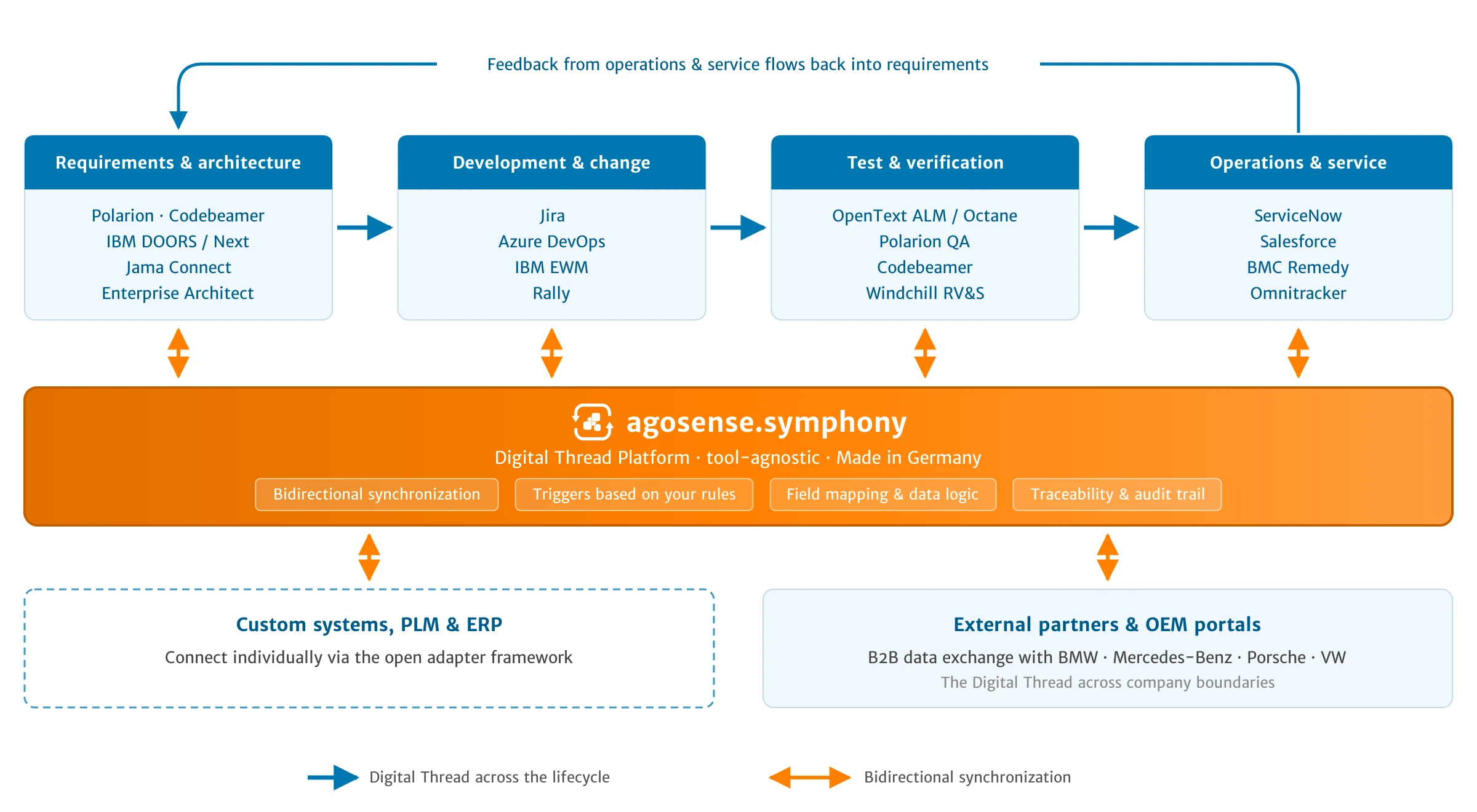
The Digital Thread with agosense.symphony: From requirement to service, internal and external
Where does your data lose its connection today?
Talk to our integration experts: We analyze your toolchain and show you where your data flow breaks today and how to build an end-to-end Digital Thread step by step.
Analyze your Digital Thread
Use Cases
Digital Thread in automotive, medical devices, aerospace and machinery
Wherever complex, software-intensive systems are developed and compliance evidence is required, a continuous data thread pays off most:
Automotive
From requirement to OEM portal
ECUs, driver assistance, software-defined vehicles: Requirements, variants and stakeholders multiply. The Digital Thread connects requirements, development and testing end to end and delivers the traceability needed for ASPICE and ISO 26262. For suppliers, it extends all the way into OEM portals: Defect reports and change requests from BMW, Mercedes-Benz, Porsche or VW flow automatically into your internal toolchain and back again. Learn more about B2B data exchange.
Medical Devices
A complete chain of evidence for every requirement
Every requirement must be verifiably tested, every change assessed and documented. A Digital Thread across requirements, change and test management creates the chain of evidence demanded by ISO 13485, IEC 62304 and FDA audits. Your teams no longer need to compile documents manually.
Aerospace
Consistent data across long lifecycles
Long product lifecycles, strict certification and distributed development partners define the aerospace industry. A continuous data thread keeps requirements, design decisions and verification evidence consistently linked for many years. This provides a solid foundation for certifications such as DO-178C.
Machinery
Field experience flows back
Machines and plants are becoming increasingly software-driven and customer-specific. A continuous data flow connects customer requirements, development, testing and service feedback. Insights from operations flow directly into the next product generation. The result is a true closed loop instead of a one-way street.
Implementation
Four steps to an end-to-end data thread
A successful Digital Thread implementation does not start with a big bang, but with a clear strategy and a first solid connection. This is how we work with you:
1
Analyze your data flow
Which tools are in use, which artifacts belong together, where do media breaks occur? Together, we identify the handoffs with the greatest leverage.
2
Define the rules
Which objects, fields and links should flow, in which direction and with which trigger? You define the rules, agosense.symphony implements them.
3
Start the first connection
Begin with one tool combination, such as requirements and development. First integrations are often live within days. If you prefer, start with a proof of concept.
4
Expand step by step
Every additional connection extends the thread: Testing, ITSM, OEM portals, custom systems. Configuration and maintenance are centralized, and the solution scales with your requirements.
References
What customers say about agosense.symphony
A Digital Thread is only as strong as the integration that carries it. That is why companies in automotive and finance have relied on agosense.symphony for years:
„
agosense.symphony has become the backbone of our entire toolchain. We knew that if we wanted to successfully establish a best-of-breed tool solution, we could only do it with a solution like agosense.symphony.
„
agosense.symphony is an essential component of our organization's integration landscape. By using this platform, we have successfully implemented and maintained complex and secure integrations over time, both between our internal systems and our clients' systems. This has allowed us to ensure reliable data synchronization and consistently deliver high-quality services.
FAQ
Frequently asked questions about the Digital Thread
A Digital Thread is the continuous, connected flow of data across a product's lifecycle. It links requirements, design, development, testing and service so that every piece of information remains traceable across all tools involved.
A Digital Twin is a virtual representation of a real-world product or system. The Digital Thread connects the data created throughout the entire lifecycle and provides origin and context. The two complement each other: Without a reliable data thread, the Digital Twin lacks its foundation.
A Digital Thread Platform is the software layer that connects data from different systems and keeps it in sync. agosense.symphony takes a tool-agnostic approach: Dedicated adapters connect ALM, ITSM and engineering tools instead of moving all data into a single vendor's repository.
No. agosense.symphony connects the tools your teams already use, such as Polarion, Codebeamer, Jira, Azure DevOps or ServiceNow. In-house systems as well as PLM or ERP systems can be connected individually via the open adapter framework. The full list is available in the integrations overview.
End-to-end traceability, faster and better-informed decisions, less manual work and improved collaboration between teams and partners. On top of that, you gain reliable evidence for audits and standards such as ASPICE, ISO 26262 or ISO 13485.
Yes. agosense.symphony connects your internal toolchain with automotive OEM portals such as BMW TAEESI, Mercedes-Benz GSEP & STARC, Porsche KPM and VW KPM. This extends the data thread across company boundaries. Learn more about B2B data exchange.
From tool silos to an end-to-end Digital Thread
Whether it is end-to-end traceability for your next audit, faster defect resolution between service and development or automated data exchange with your OEM customers: agosense.symphony extends a tool-agnostic, scalable Digital Thread across your existing toolchain, based on your rules. Talk to us about your first step.
✓ Free analysis call
✓ Discuss your individual situation
✓ Proof of concept available
✓ Test installation available
No cost, no risk – just a clear picture of where your Digital Thread breaks today.
Or use our contact form directly

agosense GmbH
Stammheimer Strasse 10
70806 Kornwestheim
Germany
+49.7154.99951.0
mail@agosense.com
https://agosense.com
Stammheimer Strasse 10
70806 Kornwestheim
Germany
+49.7154.99951.0
mail@agosense.com
https://agosense.com
PRODUCTS & SOLUTIONS
AGOSENSE.SYMPHONY
DEVELOPMENT TOOL INTEGRATION
B2B DATA EXCHANGE
INTEGRATIONS
LICENSING
SOLUTION CENTER
AGOSENSE.SYMPHONY
DEVELOPMENT TOOL INTEGRATION
B2B DATA EXCHANGE
INTEGRATIONS
LICENSING
SOLUTION CENTER
This is agosense: Automation of data flows, value stream management, connection of development tools and ALM platforms, business-to-business data exchange, connection to OEM supplier platforms.
