
 Helpdesk
 Solution Center










Leading companies worldwide like Bosch, BMW, Mercedes-Benz, VW, Continental, Infineon, Schaeffler and many more trust agosense.symphony
 agosense.symphony · Made in Germany
Toolchain Integration: Connect your development tools seamlessly
From requirement to test – without data silos. agosense.symphony connects your ALM, ITSM and engineering tools into one seamless, automated development toolchain. Every team works in their preferred tool. All data stays in sync.
✓ Bidirectional synchronization
✓ 150+ customer projects
✓ 15+ years of experience
✓ Made in Germany
✓ B2B data exchange
Integrations include
Jira
Polarion
Codebeamer
Azure DevOps
IBM DOORS
ServiceNow
Salesforce
HP ALM
BMW · Mercedes-Benz · Porsche · VW
+ All integrations →
Basics
What is a toolchain – and where do gaps occur?
A toolchain encompasses all tools that work together throughout the software and systems development process: requirements management, modeling, task management, version control, testing, and project planning. In practice, every team uses the tool that best fits their role – requirements engineers work in Polarion or Codebeamer, developers in Jira or Azure DevOps, testers in HP ALM. This is not a weakness; it is the result of a deliberate best-of-breed strategy.
The real problem occurs at the handoffs between these tools. Status changes arrive too late. Data is copied manually – and distorted in the process. Traceability from requirement to test result cannot be proven end-to-end. In regulated development environments, every data silo puts not only efficiency at risk, but also auditability.
Manual handoffs
Data is copied between tools – error-prone, time-consuming and impossible to scale.
Delayed synchronization
Status changes reach other teams too late – decisions are based on outdated data.
Incomplete traceability
The audit trail from requirement to test is missing – compliance reviews become a major effort.
Maintenance overhead
Every point-to-point interface becomes its own project with every tool update.
Technology
How agosense.symphony holds your toolchain together
agosense.symphony is built on a service-oriented architecture with a central communication bus and dedicated adapters for every connected system. Not a generic off-the-shelf connector – but the result of real enterprise projects built over more than 15 years of integration experience.
Bidirectional synchronization
Changes in both directions are detected, transformed and transferred according to defined rules. No data loss, no manual intervention.
Configurable triggers
Synchronization runs on a schedule, event-based or manually – exactly when your process requires it. Point-&-click configuration, no coding required.
Field mapping & data logic
Formulas, lookups, conditional mappings: you define which fields are transferred and how – without compromising your existing data structures.
End-to-end traceability
Every data change is logged and traceable – across all integrated systems. Audit-ready, at any time.
Supported tools include:
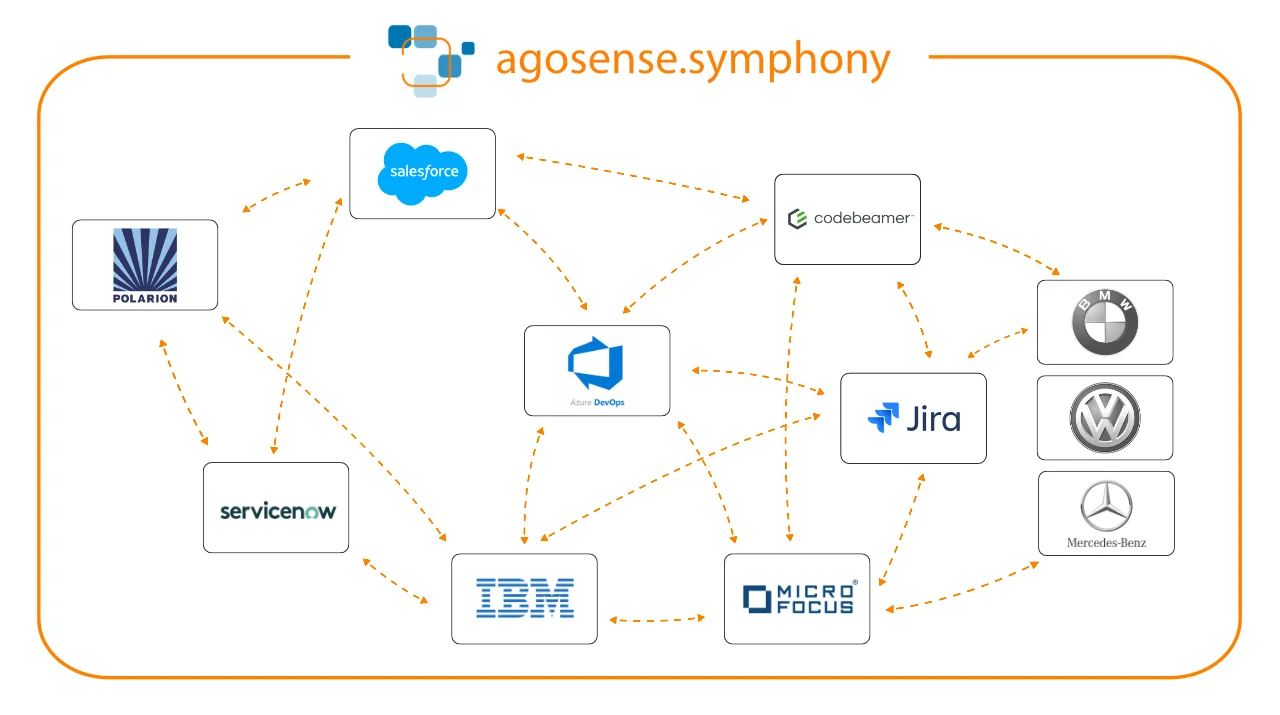
Toolchain Integration with agosense.symphony – internal and external, bidirectional & automated
Your tools work next to each other instead of with each other?
Speak with our integration experts: We analyze your toolchain, identify where manual work is costing your team time – and show you the potential a seamless integration unlocks for your traceability and development process.
Analyze your toolchain
Transformation
Toolchain without integration vs. with agosense.symphony
What the difference means in practice – at a glance:
Use Cases
Typical toolchain scenarios with agosense.symphony
Three of the most common integration patterns in practice – and how agosense.symphony solves them:
ALM Toolchain
Requirements to test: end-to-end ALM toolchain
Requirements are managed in Polarion or Codebeamer, tasks move into Jira, test results sit in HP ALM – and in between, there is silence. With agosense.symphony, requirements flow automatically as tasks into the ticketing system, status changes are synchronized bidirectionally, and test results are linked directly to the original requirements. Traceability is complete at all times – without any developer needing to open a second tool.
ITSM & ALM
ITSM meets ALM: incidents routed directly into development
An incident in ServiceNow or Salesforce should land directly as a defect or change request in Codebeamer or Jira – with the processing status flowing back automatically. agosense.symphony connects ITSM and ALM based on configurable rules: incidents are classified, created and processed according to your criteria. The result: A continuous process chain from the first customer report to the completed fix – seamless, without manual steps.
B2B & OEM
B2B toolchain: connecting to OEM portals
As a supplier, you communicate defect reports, test results and status updates through your customers' portals – BMW TAEESI, Mercedes-Benz GSEP & STARC, Porsche KPM, Volkswagen KPM. Without automation, this means considerable manual effort at one of the most error-prone points in your process. agosense.symphony handles this data exchange end-to-end: tickets flow automatically into your internal system, are processed there, and all relevant information is transferred back to the customer portal. This B2B toolchain connectivity is offered almost exclusively by agosense in the market.
Advantages
agosense.symphony for your toolchain – at a glance
What customers report after going live:
SynchronizationBidirectional, in real time
ConfigurationPoint & click, no coding required
TriggersScheduled, event-based or manual
Field mapping & data logicComments, attachments, conditional mappings
Conflict handlingRule-based, fully logged
Audit trailEnd-to-end, audit-ready
ScalabilityEnterprise-ready, multi-instance, multi-project
OEM portal connectivityBMW, Mercedes-Benz, Porsche, VW
Requirements traceabilityEnd-to-end across all integrated tools
Origin & experienceMade in Germany / Europe, 15+ years
Customer projects150+ successfully delivered
Time to first integrationFirst integration live within days
References
What customers say about agosense.symphony
Choosing an integration platform for an entire development organization is a significant responsibility. That is why real-world experience speaks louder than any promise:
„
agosense.symphony is an indispensable part of our integration environment. The platform enables us to implement complex and secure integrations – both between internal systems and to customer systems – and to operate them reliably in the long term. The result: Consistent data synchronization and a uniformly high quality of service for our customers.
„
agosense.symphony has become the backbone of our entire toolchain. We knew that if we wanted to successfully establish a best-of-breed tool solution, we could only do it with a solution like agosense.symphony.
FAQ
Frequently asked questions about toolchain integration
A toolchain describes the entirety of development tools in use and the processes between them. An integration platform like agosense.symphony is the technical layer that connects these tools and automates the data exchange between them – without replacing the tools themselves.
agosense.symphony supports all common ALM, ITSM and engineering platforms: Jira, Polarion, Codebeamer, IBM DOORS, Azure DevOps, HP ALM, ServiceNow, Salesforce and many more. In addition, custom-built systems can also be connected via an open adapter framework. The full list is available in the integrations overview.
Toolchain development refers to the deliberate selection, configuration and interconnection of development tools into a coherent process. The goal is for all stakeholders – from requirements engineers to testers – to collaborate seamlessly, without data silos or manual handoffs.
This depends on the number of tools and the complexity of the processes involved. Thanks to pre-configured connectors and a guided setup process, first integrations can go live within days. In customer projects, agosense has demonstrated a fully configured solution in a proof-of-concept within two days.
An agile toolchain connects all tools used by agile development teams – from user story to deployment. Typical combinations include Jira (backlog & sprints), Confluence (documentation), Git (code) and CI/CD tools. Integrating these tools ensures information flows without data silos and teams can focus on development.
Yes. agosense.symphony also supports cross-company toolchain integration – including connectivity to automotive OEM portals (BMW TAEESI, Mercedes-Benz GSEP & STARC, Porsche KPM, VW KPM) and standardized B2B data formats. Learn more on our B2B data exchange page.
Your toolchain integration – seamless and reliable
Whether end-to-end ALM toolchain, automated ITSM-ALM data exchange or B2B connectivity to OEM portals: agosense.symphony adapts to your processes – not the other way around. With the right integration platform, you connect your entire tool landscape into one seamless development process chain – automated, transparent and scalable for any level of complexity.
✓ Free analysis call
✓ Discuss your individual situation
✓ Proof of concept available
✓ Test installation available
No cost, no commitment – but a clear picture of what is possible for your toolchain.
Or use our contact form directly
agosense GmbH
Stammheimer Strasse 10
70806 Kornwestheim
Germany
+49.7154.99951.0
mail@agosense.com
https://agosense.com
Stammheimer Strasse 10
70806 Kornwestheim
Germany
+49.7154.99951.0
mail@agosense.com
https://agosense.com
PRODUCTS & SOLUTIONS
AGOSENSE.SYMPHONY
DEVELOPMENT TOOL INTEGRATION
B2B DATA EXCHANGE
INTEGRATIONS
LICENSING
SOLUTION CENTER
AGOSENSE.SYMPHONY
DEVELOPMENT TOOL INTEGRATION
B2B DATA EXCHANGE
INTEGRATIONS
LICENSING
SOLUTION CENTER
This is agosense: Automation of data flows, value stream management, connection of development tools and ALM platforms, business-to-business data exchange, connection to OEM supplier platforms.
