
 Helpdesk
 Solution Center









Leading companies worldwide like Bosch, BMW, Mercedes-Benz, VW, Continental, Infineon, Schaeffler and many more trust agosense.symphony
 agosense.symphony · Made in Germany
ALM Tool Integration Platform: Connect development tools and sync data automatically
Requirements in Polarion, tasks in Jira, tests in OpenText ALM, incidents in ServiceNow: Every team uses the best tool for the job. agosense.symphony is the ALM tool integration platform that connects these development tools bidirectionally, rule-based and with end-to-end traceability. Your teams stay in their tools, the data flows automatically.
✓ Bidirectional ALM integration
✓ Tool integration platform, not plugins
✓ 150+ customer projects
✓ 15+ years of experience
✓ Made in Germany
Integrations include
Jira
Polarion
Codebeamer
Azure DevOps
IBM DOORS
IBM EWM
Jama Connect
OpenText ALM
ServiceNow
Salesforce
+ All integrations →
Basics
What is an ALM tool integration platform?
Application lifecycle management (ALM) covers every phase of software and systems development, from requirements through implementation and testing to release and maintenance. Each phase has its own specialized management tools: Requirements management in Polarion, Codebeamer or IBM DOORS, tasks in Jira or Microsoft Azure DevOps, tests in OpenText ALM, service in ServiceNow.
An ALM tool integration platform, often simply called an integration platform for development tools, is the central software layer between these development tools. It connects every ALM tool to a shared bus via its own adapter, translates different data models through data mapping and synchronizes requirements, work items, test cases and defects automatically.
Without ALM integration, every handoff breaks the flow of information: Data is entered manually twice, status changes arrive too late, traceability falls apart. In an audit under ASPICE, ISO 26262 or ISO 13485, this becomes a real risk.
Differentiation
Integration platform, iPaaS or tool integration platform: Which one fits development tools?
The term integration platform covers a lot of ground. Classic enterprise integration platforms and integration platform as a service (iPaaS) mainly connect business applications such as ERP, CRM, e-commerce and cloud-based services. With pre-built connectors and API management, they share customer, order or master data from various sources. For software and systems development, that is rarely enough. Here, it is not individual records that flow, but linked artifacts with a history. A tool integration platform for development tools therefore has to do more:
Artifacts, not records
Requirements, work items, test cases and defects are synchronized with hierarchies, links, comments and attachments, not just individual fields.
Traceability & audit trail
Every link stays traceable across tool boundaries, and every change is logged. This is the foundation for ASPICE, ISO 26262 or ISO 13485.
Bidirectional, not one-way
Status and field changes flow in both directions, in near real time. Conflicts are resolved according to fixed rules.
Runs where your data lives
Many development tools run in your own infrastructure. The platform has to run there too, so sensitive development data stays under your own access controls.
In short: An iPaaS connects business processes. An ALM integration platform like agosense.symphony connects development processes.
Integration approaches
Point-to-point, ALM suite or platform: Three approaches compared
There are three ways to connect ALM tools. The difference shows by the third tool at the latest and shapes your entire integration strategy:
| Criterion | Point-to-point interfaces | Vendor ALM suite | ALM integration platform |
|---|---|---|---|
| Tool choice | Free, but a separate solution per connection | Limited to the suite | Best-of-breed, freely combinable |
| Adding a new tool | New interface to every tool | Migration into the suite | One more adapter |
| Maintenance on updates | Each interface separately | Tied to the vendor's release cycle | Central, supported by the vendor |
| Traceability | Incomplete | Only within the suite | End-to-end across all tools |
| Dependency | Sprawl of scripts | Vendor lock-in | Tool-neutral |
| External partners | Hardly feasible | Limited | B2B data exchange included |
Point-to-point interfaces
- Tool choice: Free, but a separate solution per connection
- New tool: New interface to every tool
- Maintenance: Each interface separately
- Traceability: Incomplete
- Dependency: Sprawl of scripts
- External partners: Hardly feasible
Vendor ALM suite
- Tool choice: Limited to the suite
- New tool: Migration into the suite
- Maintenance: Tied to the vendor's release cycle
- Traceability: Only within the suite
- Dependency: Vendor lock-in
- External partners: Limited
ALM integration platform
- Tool choice: Best-of-breed, freely combinable
- New tool: One more adapter
- Maintenance: Central, supported by the vendor
- Traceability: End-to-end across all tools
- Dependency: Tool-neutral
- External partners: B2B data exchange included
Rule of thumb: With five tools, the point-to-point model needs up to ten interfaces. An integration platform needs five adapters, and every additional tool costs exactly one.
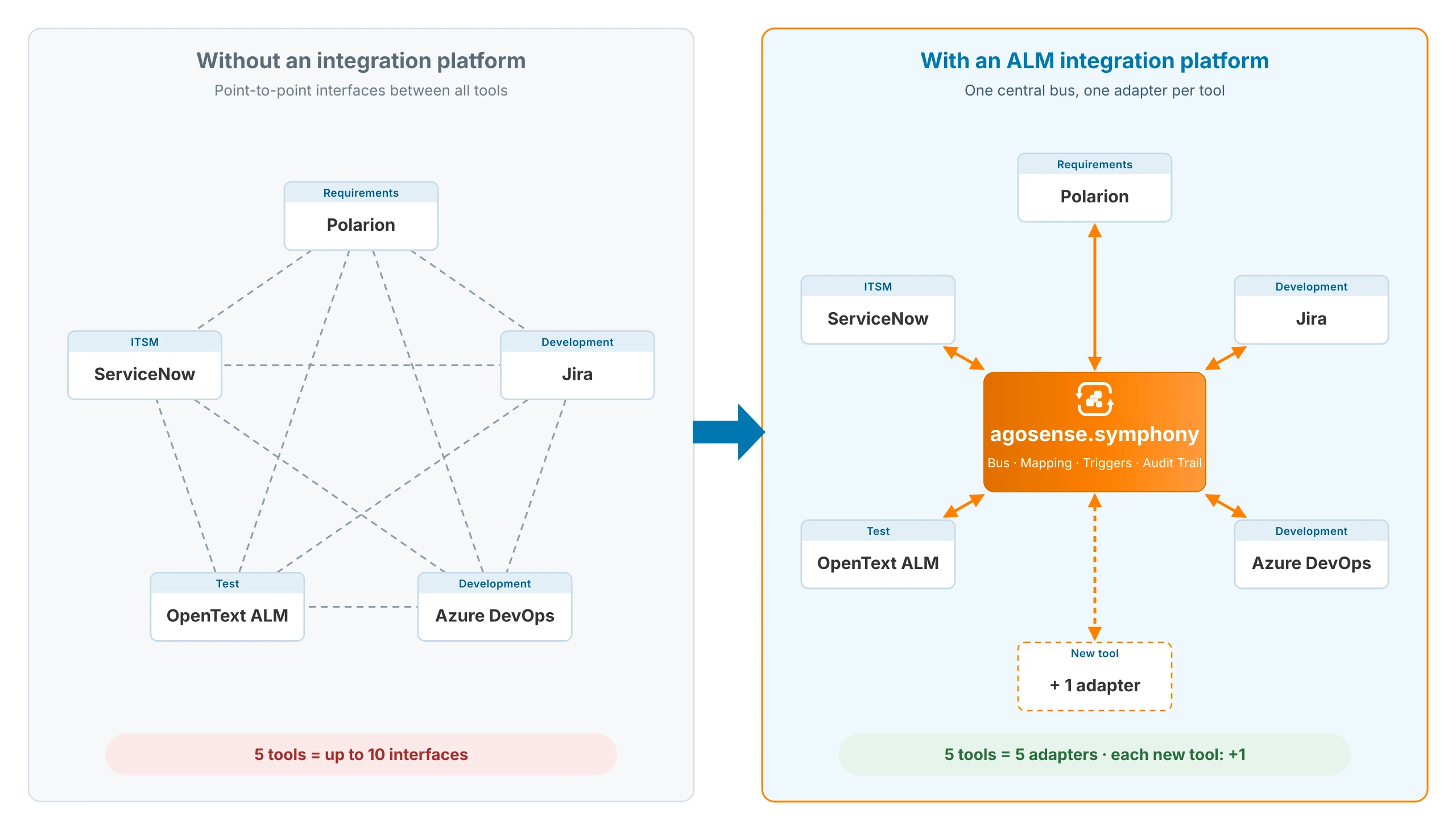
Point-to-point vs. tool integration platform: With agosense.symphony, every new tool costs exactly one adapter
Technology
agosense.symphony: The integration platform for your development tools
agosense.symphony is built on a service-oriented architecture with a central communication bus and pre-configured, dedicated adapters for every system. As a pure server application, the tool integration platform needs no client or plugin installation and runs in your own infrastructure, virtualized or via Docker if required.
Bidirectional synchronization
Requirements, work items, test cases and defects flow in both directions, with status, comments, attachments and links. Hierarchies such as epics, stories and subtasks are preserved.
Triggers on your terms
Event-based, scheduled or manual: You decide when data flows. Configuration is done via point & click.
Flexible data mapping
Formulas, lookups and conditional mappings translate custom fields and status workflows between tools.
Conflict handling & audit trail
Conflicts are resolved by rules, and every change is logged and visible in the dashboard.
All features in detail are available on the agosense.symphony product page.
Supported tools include:
Your ALM tools work next to each other instead of with each other?
Speak with our integration experts. We analyze your tool landscape and show you which handoffs to automate first.
Analyze your tool landscape
Use Cases
ALM integration in practice: Three typical scenarios
These are the patterns our customers implement most often with the integration platform:
Requirements & development
Connect requirements management with Jira or Azure DevOps
Requirements are created in Polarion or Codebeamer and implemented in Jira or Azure DevOps. agosense.symphony automatically creates epics, stories or work items from approved requirements, keeps the links up to date and reports the implementation status back. Examples: Jira Azure DevOps Integration and Codebeamer Connector.
Test & quality
End-to-end traceability from requirement to defect
Test results stay linked to their requirements. If a test fails, a defect is created automatically in the ticketing system, including the test result. This builds the chain of evidence (requirement, test, defect) that ASPICE and ISO 26262 demand. A major Swiss bank does exactly this with Polarion, Quality Center, Jira and Enterprise Architect.
ITSM & ALM
Incidents from ServiceNow straight into development
An incident in ServiceNow or Salesforce is created as a defect or change request in the ALM tool based on defined criteria, and the status flows back automatically. Learn more: ServiceNow Jira Integration.
References
What customers say about agosense.symphony
An ALM integration platform quickly becomes the backbone of development. At a major Swiss bank, agosense.symphony connects the toolchain of more than 2,000 developers:
„
agosense.symphony has become the backbone of our entire toolchain. We knew that if we wanted to successfully establish a best-of-breed tool solution, we could only do it with a solution like agosense.symphony.
„
The modular and scalable concept of agosense.symphony, consisting of the bus technology and the individually adaptable adapters, has a future. That is what Amadeus Germany is counting on!
FAQ
Frequently asked questions about ALM integration
It connects the tools of application lifecycle management via adapters and a central bus. Data is synchronized automatically and rule-based, and every team stays in its own tool.
An iPaaS mainly connects business applications such as ERP or CRM. A tool integration platform specializes in development tools: It synchronizes artifacts with hierarchies and links and ensures traceability across all tools.
Among others Jira, Polarion, Codebeamer, IBM DOORS, IBM EWM, Jama Connect, Microsoft Azure DevOps, OpenText ALM (formerly Micro Focus ALM/QC), ServiceNow and Salesforce. Custom-built systems connect via the open adapter framework. You will find all tools in the integrations overview.
Yes. agosense.symphony is an enterprise integration platform for ALM, DevOps and ITSM environments. Like these solutions, it synchronizes requirements, test cases and defects with hierarchies, comments, attachments and traceability links. In comparison, agosense.symphony sets four distinct priorities:
B2B and OEM interfaces: Ready-made adapters for supplier portals such as BMW TAEESI, Mercedes-Benz GSEP & STARC as well as VW and Porsche KPM. Tickets and requirements flow securely between you, your customers and your suppliers.
No-code configuration & own adapter framework: You configure workflows, triggers and field mappings via point & click. Custom-built systems connect via the open adapter framework.
Vendor based in Germany (EU): Development and support are based in Germany, and your development data stays in your own infrastructure.
Server-based license instead of per-user pricing: Unlimited users, projects and connections. For large development organizations, this means significant cost savings.
agosense.symphony is a particularly good fit if you develop in automotive, aerospace, medical devices or mechanical engineering in Europe, especially in the DACH region, or exchange data with OEMs and suppliers.
Many sync solutions, such as apps from the Atlassian Marketplace, base their price on the number of users. With hundreds or thousands of developers, that adds up quickly. agosense, by contrast, licenses per server: unlimited users, projects and connections. Costs stay predictable, even as more teams, sites or tools are added. The platform runs on-premise, via Docker or in a cluster.
Every synchronization is logged, and conflicts appear in the dashboard. Combined with cross-tool links, this creates solid evidence for audits.
First connections are often live within days. For a major Swiss bank, agosense delivered an individually configured solution in a proof of concept within two days.
Yes, for example to OEM portals such as BMW TAEESI, Mercedes-Benz STARC, Porsche KPM or VW KPM. Learn more about B2B data exchange.
From tool silos to a seamless development process chain
Whether requirements and development, test and defects or ITSM and ALM: agosense.symphony connects your development tools the way your processes require. Start with a first connection and expand your ALM tool integration platform step by step.
✓ Free analysis call
✓ Discuss your individual situation
✓ Proof of concept available
✓ Test installation available
No cost, no commitment – but a clear picture of what an integration platform can do for your ALM tools.
Or use our contact form directly